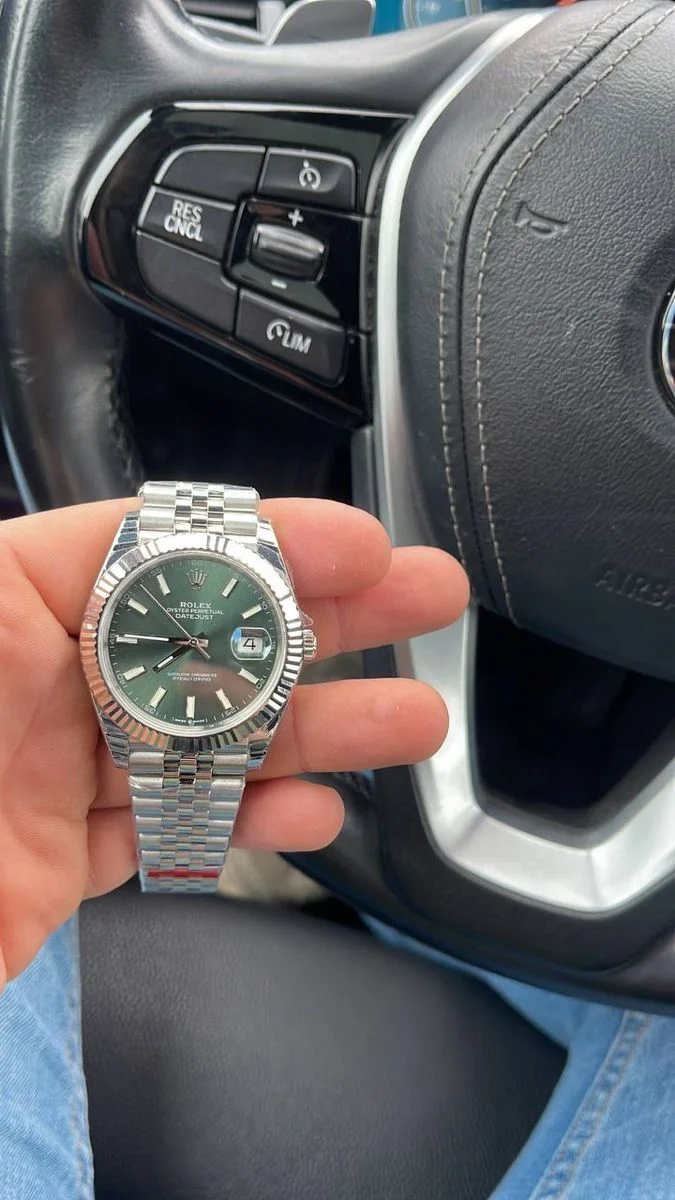
Short answer: Most Rolex watches have a mechanical automatic movement, so their second hand appears to “sweep” smoothly across the dial rather than making a once‑per‑second audible tick. Technically, the hand moves in many rapid micro‑steps (typically 8 beats per second on modern Rolex movements), producing a smooth visual sweep; a few Rolex models (historic Oysterquartz and some rare quartz examples) do tick once per second.
Detailed explanation
To understand why Rolexes usually sweep, it helps to know the difference between movement types. Rolex is best known for its mechanical movements—automatic calibers powered by a wound mainspring and regulated by a balance wheel and escapement. The escapement releases energy in small, rapid increments called “beats” or “ticks.” Modern Rolex calibers commonly run at 28,800 beats per hour (bph), which equals 8 beats per second. Those 8 tiny steps each second create the visual effect of a continuous or smooth sweep.
However, the sweep of a mechanical Rolex is not mathematically continuous like a motor‑driven glide; it is a fast sequence of micro‑ticks. In contrast, quartz watches typically step the second hand once per second (1 Hz), producing the familiar audible “tick‑tick” and a noticeably jumping second hand. Rolex did produce quartz models—most famously the Oysterquartz in the 1970s–2000s and some Cellini quartz pieces—which will tick once per second like other quartz watches.
There are also technologies from other makers (for example, Seiko’s Spring Drive) that achieve a truly continuous, frictionless glide of the second hand; Rolex does not use Spring Drive and therefore its sweep is the classic high‑frequency mechanical sweep, not a continuous electronically controlled glide.
Key reasons / factors
- Movement type: Automatic/mechanical Rolex movements produce multiple beats per second (sweep). Quartz Rolexes (rare) tick once per second.
- Beat rate (Hz / bph): Most modern Rolex calibers run at 28,800 bph (4 Hz) producing ~8 ticks per second—visually smooth. Some older or specialty calibers may vary.
- Power reserve & amplitude: When the mainspring is nearly depleted or the balance amplitude is low, the sweep can slow or become more noticeable as discrete ticks.
- Servicing and lubrication: Poorly serviced movements or dried oils can alter the regularity and audible profile of ticks, making a normally smooth Rolex sound or look more “ticky.”
- Model variation: Oysterquartz models, vintage quartz Cellini, and aftermarket quartz conversions will tick. Most contemporary Oyster, Submariner, Datejust, GMT‑Master, Daytona (mechanical), and similar models sweep.
- Perception and photography: High‑frame‑rate video or certain lighting can reveal the tiny steps of the second hand, even if the eye perceives a smooth sweep.
Comparison
- Rolex mechanical (typical): 28,800 bph → visually smooth sweep; slight micro‑steps; quiet mechanical sound if any.
- Rolex quartz (Oysterquartz/Cellini quartz): 1 Hz → distinct once‑per‑second tick and visible jump between seconds.
- Typical quartz watches (non‑Rolex): 1 Hz → similar pronounced tick, very common and inexpensive to produce.
- Seiko Spring Drive / other glide systems: True continuous glide with no perceptible steps; different technology from Rolex’s mechanical sweep.
- High‑beat movements (e.g., 5 Hz/36,000 bph): Even smoother-looking sweep than 4 Hz; some brands use higher frequencies for increased smoothness and accuracy—Rolex sticks to its proven frequencies for torque and longevity.
Pros and Cons
- Pros of Rolex sweep (mechanical):
- Elegant, fluid visual motion associated with luxury watches.
- Mechanical engineering and craftsmanship appeal to collectors.
- Less audible ticking noise than 1 Hz quartz watches.
- Cons of Rolex sweep (mechanical):
- Not truly continuous—still incremental movement—so purists may prefer true glide systems for absolute smoothness.
- Requires regular servicing and maintenance to keep optimal beat rate and smoothness.
- Slightly lower instantaneous accuracy than quartz, though Rolex mechanicals are highly accurate for their class.
- Pros of quartz ticking:
- Excellent accuracy and low maintenance (battery changes).
- Distinct second hand jumps can aid time reading at a glance.
- Cons of quartz ticking:
- Perceived as less prestigious among mechanical watch enthusiasts.
- Audible ticking may be undesirable to some owners in quiet environments.
FAQs
Does every Rolex have a sweeping second hand?
No. Most modern Rolexes with mechanical automatic movements have a sweeping second hand, but Rolex produced quartz models (notably the Oysterquartz and some Cellini references) that tick once per second. If you see or hear a Rolex ticking like a quartz watch, check the model and movement.
Why does my Rolex sound like it’s ticking loudly?
A normally functioning Rolex is relatively quiet. Loud ticking can indicate low power reserve, a service requirement, loose case back, or an external factor (bracelet or case making noise). If the sound is abnormal, have a certified watchmaker or Rolex service center inspect it.
Can the sweep indicate authenticity of a Rolex?
Sweep alone isn’t definitive proof of authenticity. Some counterfeit watches mimic a sweep by using a high‑frequency quartz stepper motor. The best way to authenticate a Rolex is through serial/model numbers, movement inspection by a professional, and provenance/documentation.
Is Rolex’s sweep as smooth as Seiko’s Spring Drive?
No. Rolex’s sweep is a result of mechanical beats and is very smooth visually, but Seiko’s Spring Drive produces a truly continuous, frictionless glide with no perceptible steps. They are different technologies with different aesthetic and technical appeals.
Does the number of ticks per second affect accuracy?
Higher beat rates can improve short‑term precision and stability but can increase wear and demand more robust lubrication. Rolex balances beat rate, torque, and longevity in its calibers to achieve reliable accuracy without sacrificing durability.